Research Reports
Bring a market, competitor, customer, brand or product question. Choose Express or Pro, review the scope and price, then read the findings and source references online or in PDF.
Explore research reports

Research your market with a focused business report. Or use Executive Editor to write, model, review and publish your own decision paper.
Reports: choose Express or Pro and review the price before paying. The TDP editor: write and publish with your existing account. No report purchase required.
One TDP workspace. Research, write, decide.
Order focused business research, or work in your own editor. The editor is part of TDP, alongside Research Reports. No research-report purchase is required to start writing.
Bring a market, competitor, customer, brand or product question. Choose Express or Pro, review the scope and price, then read the findings and source references online or in PDF.
Explore research reportsWrite, model, collaborate and publish in one decision paper. For investment memos, strategy papers and team recommendations that need a clear record of the reasoning.
Sign in with your TDP account to write, review and publish.
Inside the TDP editor
Keep the writing, assumptions, evidence and review in the same workspace. Follow a linked paper in the editor example below.
See the editor exampleDraft and format a decision paper with footnotes, references and editable page flow. Keep your sources beside the reasoning.
Connect tables and calculations to charts, timelines, decision trees and option cards. Compare scenarios and probability-weighted outcomes.
Collaborate in shared workspaces, discuss anchored comments and assign review tasks. Compare branches and resolve merge conflicts before creating a new draft.
Inspect proposed changes and their supporting evidence before accepting them. Native writing and modelling also work without AI.
Select prose, table values and diagram data for a reviewed redacted draft. Analytical extracts become static values, without their underlying formulas or source records.
Freeze a saved version and export HTML, PDF or editable Word. Share watermarked copies with named recipients, expiry and download controls.
PDF preserves the frozen proof layout; editable Word can reflow. Expiring or revoking a recipient link stops future access, but cannot recall a downloaded copy. Enterprise deployment qualification is ongoing.
Your question, researched. Structured reports shaped around your business.
Findings with context. Supporting sources and analysis.
Practical next steps. Read online. Take the PDF with you.
The Decision Pattern is an AI-assisted business research platform. We turn your questions into structured reports with supporting sources, analysis, and practical next steps.
For founders, business owners, marketing and product teams, agencies, and consultants worldwide. Explore a question from your industry below, or find a starting point for the work you do.
Explore who it’s forExplore demand, competing providers, and barriers to entering a new market.
Research this questionExample question. Set your own geography, audience, and scope next.
Find the report that fits your question. From the bigger market picture to the details of your next product idea.
Compare report typesThe competitor tabs. The customer notes. The market report you saved. Bringing them together is a job in itself.
Start with your question. Put the evidence around it.
See how we researchUnderstand where to grow, whom to serve, and what to investigate before investing—with research shaped around your business.
A new market. A different audience. An idea worth exploring. Give your research the context that makes it useful to your business.
Illustrative report preview
Read the findings and source references together. Understand the assumptions and the questions that still need an answer.
Read online or download the PDF. Bring the research to your next team meeting, client conversation, or business decision.
Morning commuters and remote workers.
Ask customers what would bring them back.

You’ve put time, money, and care into your business. Research the people and possibilities behind your next decision.
Research this questionOur café is ready to grow. Who should we focus on next?
A useful starting point: compare local audiences, nearby cafés, and the needs worth testing before you expand.
What would bring those customers back?
Follow a café’s research question from the first brief to findings and next steps. Explore each step at your own pace.
Which customer groups should our café focus on?
Your context gives the research a useful starting point.
Step 1 of 3: Ask a question
Follow the wider market, inspect the evidence, and find the questions your team should test next.
Explore demand, competitors, and the context around the question you’re asking.
Read the source alongside the finding. See the assumptions that still need checking.
Turn findings into questions your team can test, before committing time and money.
Compare the research, analysis, and next steps included with each report. Choose the depth your question needs.
| Find the depth that fits. Compare what’s included. | Express report$10per report · USD A focused overview with essential findings and initial next steps. | Pro report$50per report · USD Deeper research with detailed comparisons, frameworks, and strategic recommendations. |
|---|---|---|
| Research | Essential findings and market context | Expanded research and source references |
| Analysis | A focused review of your question | Detailed frameworks and comparisons |
| Next steps | Initial directions to investigate | Strategic recommendations and next steps |
| Choose your report | Choose Express | Choose Pro |
Online report and complete PDF included.
One-time purchase. No subscription.
Research for more than one question? Commission separate reports for different markets, products, or client projects.
Discuss your researchYour business context goes in. The findings, sources, and next steps come together in one report.
A published statistic is a starting point. See the source, the interpretation, and the questions to explore next.
20%
of EU enterprises in the survey scope used AI technologies in 2025.
EurostatPublished 11 December 2025Check the year, the population, and the original publication. Here, the scope is EU enterprises with 10+ people employed, in the surveyed sectors.
Adoption can suggest a direction to investigate. It does not establish demand for your product or tell you which customers to serve.
Customer needs, existing alternatives, and willingness to pay need further research. Keep those questions visible before committing.
Find the report, research depth, and support that fits your next question.
Read online. Download the PDF. Bring it to your next conversation.

Choose the depth your question needs.
Express$10
Pro$50
USD · per report

What to choose, what you receive, and how to use the research.
Ask us a questionExplore markets, competitors, customer segments, brand perception, and product opportunities. Choose the report type that matches your question, then define the scope and depth you need.
No. You can start with a business question or topic. Add company context, your audience, and geography where they help define the research.
Express offers a focused first look at your business question. Pro goes deeper into the analysis, frameworks, and recommendations. Review the scope and included deliverables before payment.
Yes. Download the complete report as a PDF once its export is ready, so you can read and reference it outside the platform.
No. Research can identify evidence, alternatives, and assumptions worth investigating. Willingness to buy needs to be established through customer research or real-world testing. A product research report does not include new customer interviews or live product testing.
Review important claims and their sources before making consequential decisions. AI-assisted research may miss information, misinterpret evidence, or produce errors. Validate critical assumptions with your own expertise and primary research.
Bring your curiosity. Leave with a clearer view of what comes next.
Start your researchSome decisions deserve more than an answer.
Executive brings research, analytical models and review into one decision paper. So the people committing capital can inspect the work behind the recommendation.
Open the workbenchSign in with your TDP account. Write and publish without an AI key.
The investment depends on demand, power availability and delivery timing. An industry outlook alone cannot validate the economics of a particular site.
Research retains the exact excerpt and locator, together with the source identity, publication date and revision.
An open question stays open until its evidence supports an answer.
Advance the phased option to the next diligence gate. Initial capital assumption: $145m. Release further capital only after demand and power availability have been validated.
| Approach | Capital | 5-year NPV |
|---|---|---|
| Extend existing | $85m | $13.56m |
| Phased deployment | $145m | $40.75m |
| Full scale | $215m | $38.98m |
Illustrative USD figures. Five years. 10% discount rate.
Decision owner: Investment sponsor. The recommendation remains conditional on the evidence and execution plan below.
An accepted risk stays visible. An approval belongs to an exact revision.
A decision paper has a memory.
Its sources. Its assumptions. Its changes. Its conditions.
Executive brings the evidence, calculations and unresolved questions into one paper. So the people making the decision can see what is known, what is assumed and what still needs to be established.
Read more| What the research says | Basis | Status |
|---|---|---|
| Source | Scoped | |
| Claim | Unverified | |
| Model | Illustrative | |
| Source | Retained |
Site-level demand and grid readiness remain to be established.
Public industry research cannot resolve private site readiness.
Site-level demand · Unverified. Site demand is unverified.
A market outlook is not a site-level demand case. A benchmark is not your deployment. Keep the supporting passage and its limitations beside the claim, where a reader can judge the connection.
A number changes the model. The model can change the decision. Inspect the chain before you accept a revision.
USD millions. The faint bar retains the original result.
Try the lower cash flow to see why the recommendation needs scrutiny.
NPV = −145 + ∑ (annual cash flow ÷ 1.1ᵗ), for years 1–5. Inputs are USD millions, with annual cash flows at period end. Display rounded to two decimal places; calculated by the workbench’s deterministic engine.
Your recommendation remains your judgment.
Linked results update. Dependent conclusions need review.
An approved recommendation is never silently rewritten.
Keep the paper and its analytical basis connected at every stage.
What would reverse the preferred investment?
The question stays connected to the recommendation.
Capture what you need to establish, the claims it affects and the questions that remain open.
Connect a finding to its exact passage, source context, limitations and opposing evidence.
Source identity, locator and relevant dates beside the claim.
Record where evidence fits and what it leaves unproven.
Retain opposing findings and unresolved contradictions.
Revisit the question without erasing its earlier basis.
Five years. 10% discount rate. Illustrative inputs.
Work in a native table. Inline and expanded views edit the same analytical object.
Trace the calculation into its chart and decision basis, rather than maintain separate copies.
Currencies, engineering units and periods give inputs meaning.
Missing values and calculation errors stay visible.
Compare cases through recorded input overrides.
Charts follow retained calculations and source mappings.
Add criterion: Delivery schedule
A proposal is reviewed before it changes the paper.
Keep writable targets separate from readable context. Existing references and formulas retain their identities.
Review the differences, supporting evidence and affected analysis against the version you saw.
Change the selected wording or native analytical object directly.
Propose a revision using the evidence already in the paper.
Revisit a question through a separately scoped research action.
Run the deterministic model against its current inputs.
Authorize the next diligence gate.
Outstanding conditions remain part of the record.
Put material changes, accountable owners and outstanding conditions beside the recommendation.
The recorded rationale and conditions stay bound to the exact revision the reviewer considered.
Compare the current basis with the previous review.
Keep acknowledged risks and accountable owners in view.
Record what must be established before proceeding.
Later edits leave the published revision unchanged.
Illustrative workflow. Native editing and analysis work without AI. Live research is still being qualified.
Build the paper and the analysis together. Keep sources, assumptions and competing explanations close to the work they inform.
Explore the research workbench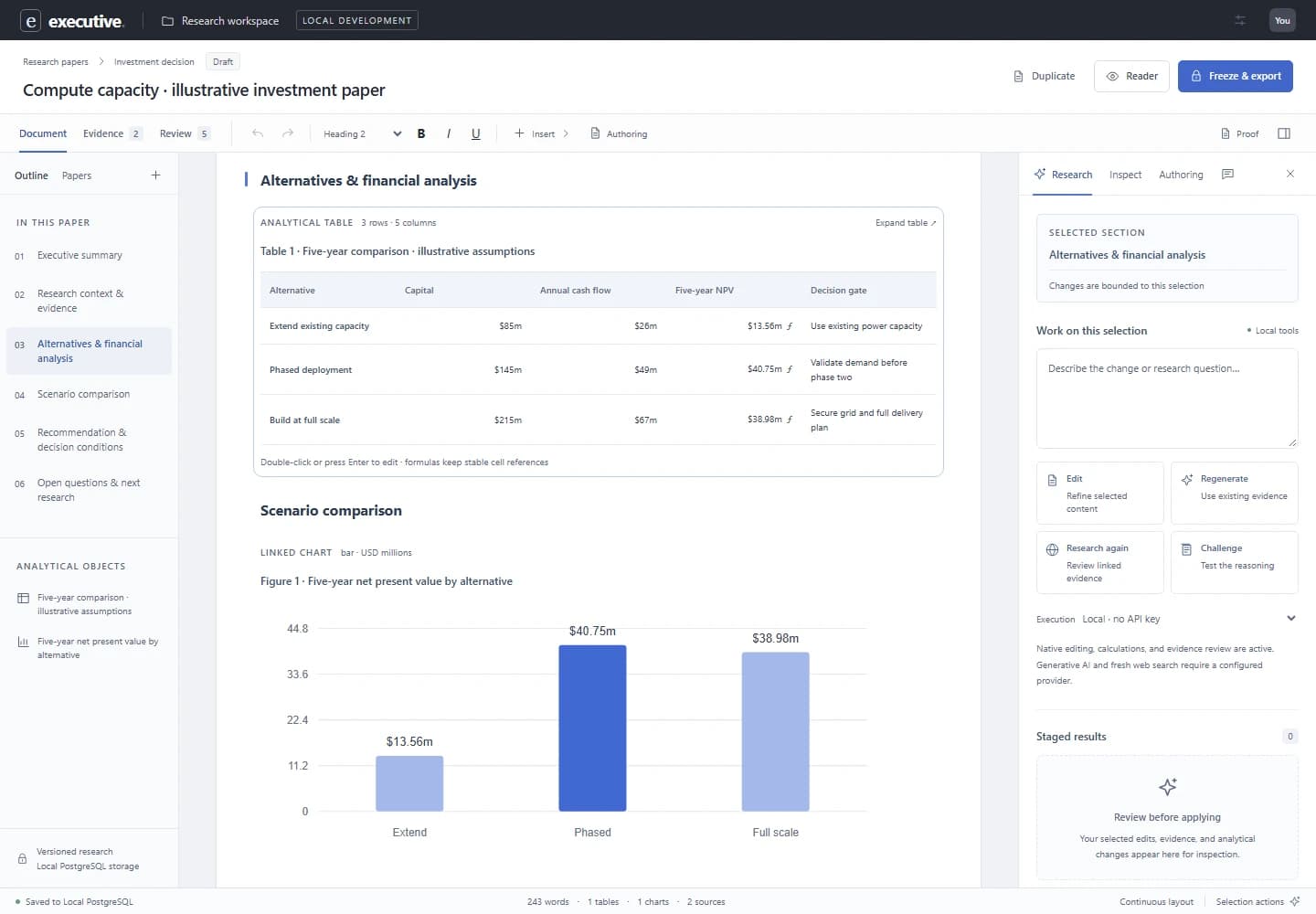
Read the recommendation with its consequences in view. See what changed, who owns the open issues and what must happen before capital is committed.
Explore executive review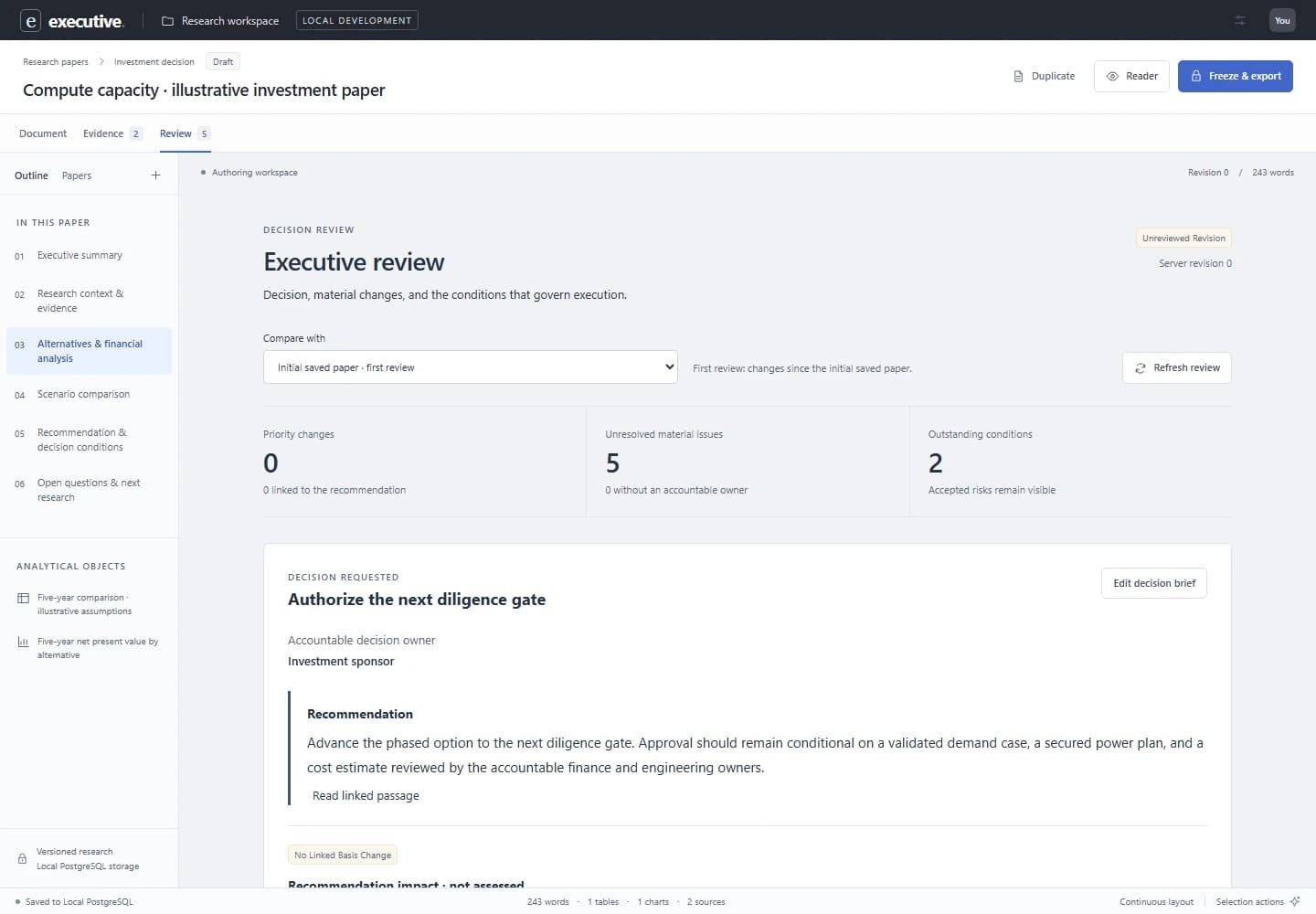
For research teams preparing the work, and executives who need to understand what they are being asked to decide.
What makes this the right use of capital?
Compare alternatives, cash flows and scenarios. Show the assumptions that could reverse the recommendation and the conditions for releasing capital.
What does the evidence actually establish?
Compare benchmarks, engineering units, total cost and dependencies. Keep untested capabilities and unresolved technical questions explicit.
What if the world develops differently?
Test competing explanations and strategic options against market evidence. Keep previous findings when new research changes the picture.
See the recommendation, what changed and what remains unresolved before you commit.
Explore executive reviewWhat changed since the previous review?Reviewer
Decision paperAnnual cash flow moved from $49m to $42m. Five-year NPV moved from $40.75m to $14.21m.
The recorded recommendation stays intact. Its analytical basis needs another review.
Keep the demand and power conditions open.Reviewer
A reviewer should not have to reconstruct a week of analysis to understand what changed. Bring the recommendation, its material changes and remaining conditions into focus.
Open an illustrative investment, technology or strategy paper. Inspect its evidence and calculations. Or begin with a blank document and enter your own analysis.
Explore the workbenchEditor shares your TDP account. Create a paper, review a saved revision and publish it without purchasing a research report.
Yes. Writing, formatting, native tables, formulas, scenarios, charts and executive review work without a model or API key. You can also convert selected prose into editable objects using local excerpts. Live AI actions require a configured provider and your review before changes are accepted.
You review the differences, supporting evidence and affected analysis first. Valid operation groups are applied to the targets and dependencies you reviewed. If their basis has changed, another review is required. You can continue ordinary editing without accepting a proposal.
Freeze a saved revision and export HTML, a paginated PDF or editable Word. PDF preserves the proof layout; Word can reflow. Named-recipient links support expiry, watermarks and download controls. Later edits leave the frozen publication unchanged, and revoking a link cannot recall an already downloaded copy.
Editor is a customer-facing feature of TDP with personal and team workspaces, review roles and administrator controls. Your existing TDP account provides sign-in, and no research-report purchase is required. One author edits a paper at a time; reviewers can inspect its saved revision. Enterprise sign-in and account provisioning can be configured by your platform administrator.
A clearer view of the market.
A more considered next move.